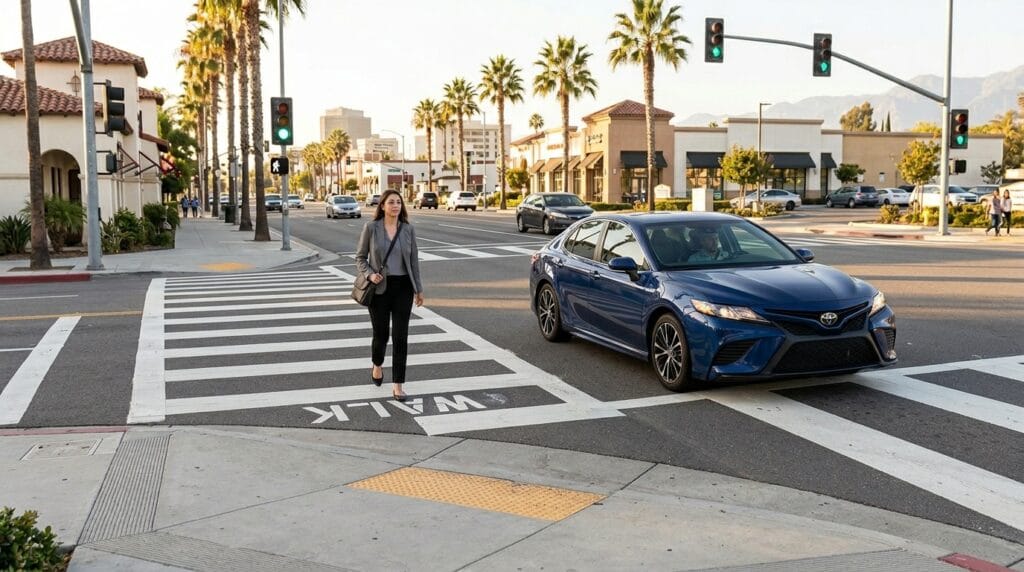
A Riverside pedestrian accident claim can become serious fast. One driver looks down for a second. Another rushes through a right turn. A pedestrian starts crossing with the signal. Then a normal walk turns into an emergency.
Pedestrian crashes are not minor incidents. A person on foot has no seat belt, airbag, helmet, or steel frame. Even a low-speed impact can cause broken bones, brain injuries, spine trauma, internal injuries, knee damage, shoulder injuries, or permanent pain. When a larger vehicle hits a pedestrian, the damage can be life-changing.
Riverside County officials have recently warned the public about deadly pedestrian crashes in the region. Local reports also pointed to distracted drivers, impatient motorists, and right-turn dangers near active crosswalks. That makes this topic important for anyone walking near intersections, shopping areas, schools, parking lots, or busy commercial roads.
The legal issue is not only whether the pedestrian had the walk signal. A strong claim may also ask deeper questions. Did the driver fail to yield? Did the driver turn too fast? Did the driver look for people in the crosswalk? Was the pedestrian visible? Did road design, lighting, parked cars, or video evidence affect fault?
Why Riverside Pedestrian Accident Claims Are a Growing Concern
Pedestrian safety remains a major issue across the United States. The Centers for Disease Control and Prevention reports that thousands of pedestrians die on American roads each year. The CDC also identifies speed, location, vehicle size, and alcohol as major risk factors. You can review the CDC pedestrian safety guidance here: CDC Pedestrian Safety.
These risk factors matter in Riverside. Many local roads carry fast traffic through areas where people still need to walk. Drivers may pass through commercial corridors, school zones, residential streets, parking lots, freeway ramps, and wide intersections. Pedestrians may cross near stores, bus stops, apartments, medical offices, schools, or workplaces.
A driver may blame the pedestrian right away. The driver may say the person “came out of nowhere.” That phrase often hides the real issue. Did the driver actually look before turning? Did the vehicle block the pedestrian’s path? Was the driver distracted by a phone, navigation app, passenger, or traffic pressure?
A Riverside pedestrian accident claim needs evidence. Without proof, the insurance company may reduce the claim or blame the injured person. With strong proof, the victim can show how the crash happened and why the driver should be responsible.
Right-turn crashes can create serious fault disputes
Right-turn crashes are common in pedestrian cases. They often happen when a driver focuses on traffic coming from the left. The driver looks for a gap, starts turning, and misses the person crossing from the right or directly ahead. This mistake can cause a crash even when the pedestrian had the legal right to cross.
Drivers must pay attention to the whole intersection. They cannot only watch cars. They must also watch pedestrians, cyclists, children, seniors, and people using mobility devices. A walk signal does not protect a pedestrian if the driver ignores the crosswalk.
Riverside-area reports have warned that pedestrians should not rely only on traffic signals. That does not remove the driver’s duty. It simply shows the risk. A pedestrian can do everything carefully and still get hurt because a driver rushed the turn.
Crosswalk signals do not end the investigation
A walk signal helps the pedestrian’s case, but it does not answer every legal question. The claim may still need video, witness statements, photos, police notes, and medical records. These details can show timing, visibility, driver behavior, and impact location.
For example, the crash may involve a driver who rolled through a red light before turning. Another driver may turn right without stopping. Some drivers block the crosswalk while looking for traffic. Others enter the turn while staring at a phone or navigation screen.
Victims should document the scene quickly. Photos should show the crosswalk, signal lights, stop line, traffic signs, parked vehicles, lighting, lane markings, and any blocked views. If stores, homes, buses, or nearby vehicles had cameras, their footage may disappear within days.
Distracted driving can change the value of the claim
Distracted driving can make a pedestrian crash more serious. A distracted driver may fail to brake, fail to yield, or fail to see a person already in the crosswalk. The result can be a harder impact and worse injuries.
Phone use is only one form of distraction. A driver may also look at a GPS screen, adjust music, talk to passengers, eat, reach for an item, or focus on traffic in only one direction. The key question is whether the driver paid enough attention before moving through the intersection.
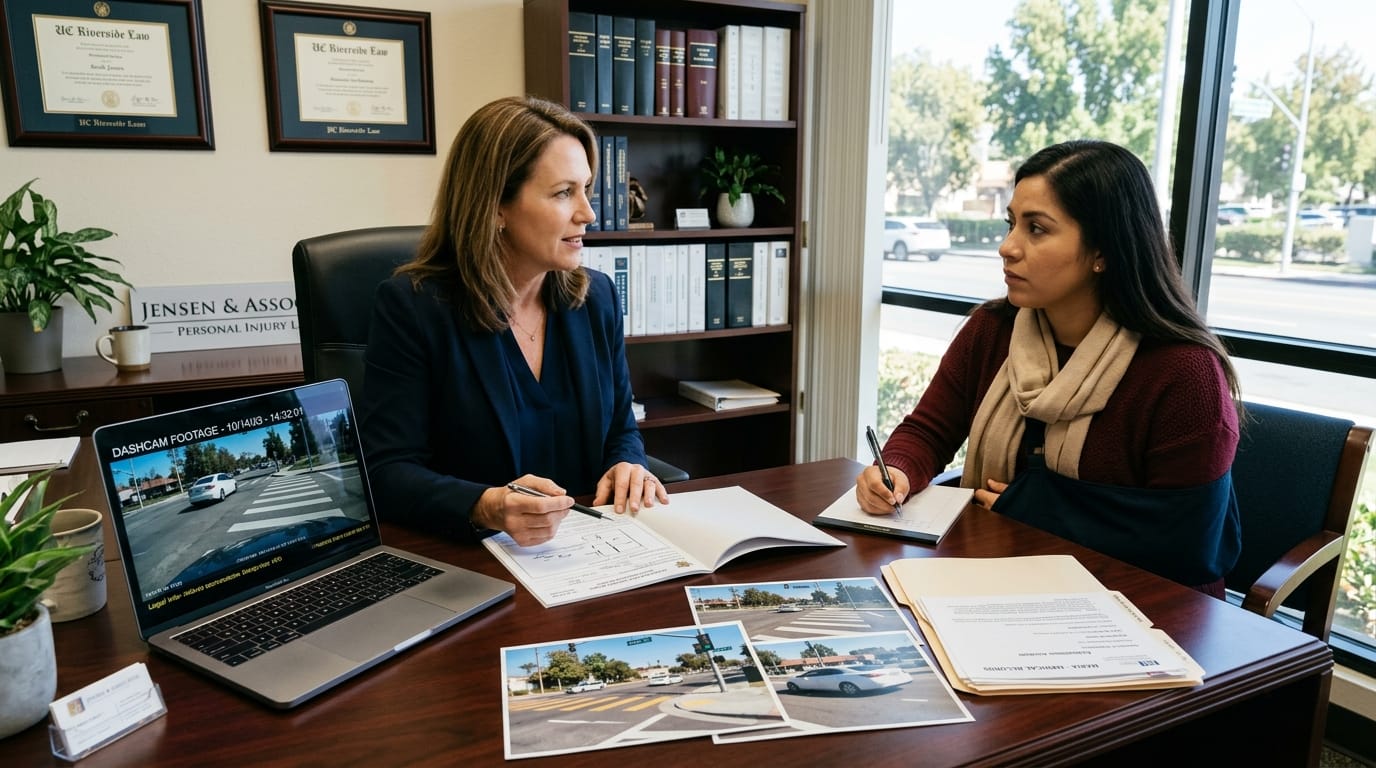
Evidence of distraction may come from witness statements, phone records, dashcam footage, traffic video, vehicle data, or the driver’s own comments. Your site already has a useful guide on Riverside dashcam and black box evidence in 2026. That internal article fits well because video and vehicle data can help prove what happened before impact.
Comparative fault is a common insurance defense
Insurance companies often argue comparative fault in pedestrian cases. They may say the pedestrian crossed too late, looked down, wore dark clothing, stepped outside the crosswalk, ignored traffic, or failed to watch turning vehicles. These arguments can reduce compensation if the insurer proves them.
California uses comparative fault rules. That means a victim may still recover compensation even if they share part of the blame. However, the amount may decrease based on the assigned percentage of fault.
This is why the injured person should avoid casual statements. Do not say, “I should have looked better,” or “I did not see the car,” before the facts are clear. Those comments can hurt the claim. A person may not know yet whether the driver was speeding, distracted, turning illegally, or ignoring the right of way.
What if the driver says the pedestrian came out of nowhere?
This defense is common, but it is not always true. A driver may say it because they failed to look. They may also say it because they want to shift blame. A proper investigation can test the claim.
Video may show the pedestrian was visible before impact. Witnesses may confirm the pedestrian had the signal. Photos may show the driver had a clear view. Vehicle damage may show where the impact happened. Police notes may also show whether the driver admitted distraction or failed to yield.
Road design can matter too. Parked cars, large vehicles, poor lighting, faded markings, wide lanes, and blocked corners may affect visibility. Your site already covers related visibility issues in Riverside crosswalk accident claims and California daylighting rules. That internal link supports this section because visibility often shapes fault in pedestrian cases.
How to Protect a Riverside Pedestrian Accident Claim
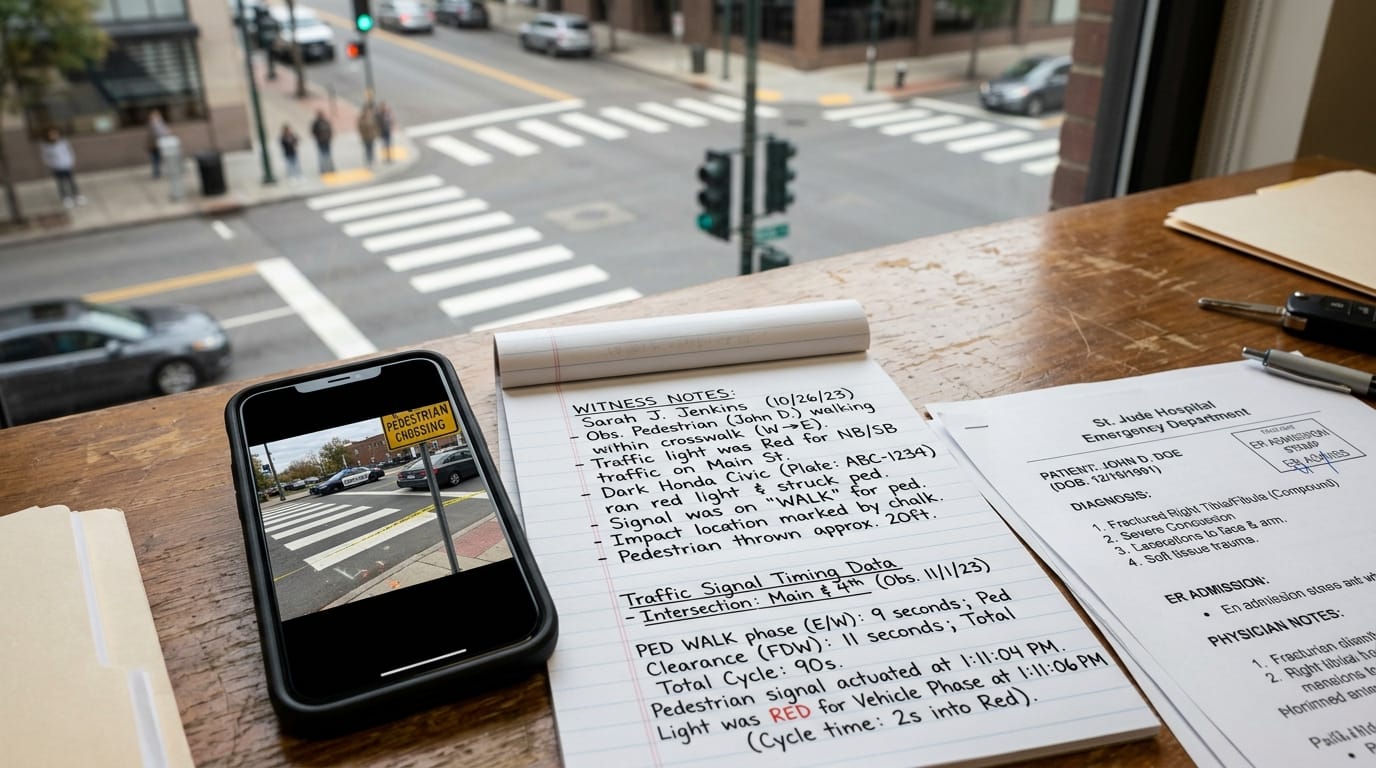
After a pedestrian crash, medical care comes first. Call 911 if the injury is serious. Even if the person feels alert, they should still get checked. Adrenaline can hide pain. Head injuries, internal trauma, fractures, and soft tissue injuries may worsen later.
The victim or a trusted person should gather evidence as soon as possible. Take photos of the vehicle, crosswalk, traffic lights, injuries, shoes, torn clothing, road signs, skid marks, debris, and final resting positions. Get the driver’s name, insurance, license plate, and contact details.
Witnesses can make or break the case. Ask for names and phone numbers before people leave. Some witnesses may have seen the driver looking down, turning too fast, or failing to stop. Others may confirm the pedestrian had the signal.
Medical records and injury proof matter
A Riverside pedestrian accident claim depends on injury proof. Medical records connect the crash to the harm. They also show the treatment timeline. Emergency care, imaging, surgery, physical therapy, specialist visits, medication, and follow-up appointments may all affect the value of the claim.
Victims should report all symptoms to medical providers. Headaches, dizziness, neck pain, back pain, numbness, knee pain, shoulder pain, sleep problems, anxiety, and memory issues can matter. Do not minimize symptoms to sound strong. Accurate medical notes help protect the claim.
Children and seniors may need special attention. A child may struggle to explain pain. An older adult may face complications after a fall or fracture. Your site’s article on Riverside school zone accident claims is a good internal link for cases involving children, school traffic, and driver responsibility near crossings.
Do not accept a quick settlement too early
Insurance companies may call soon after the crash. They may ask for a statement or offer a fast settlement. That offer may sound helpful, but it may not include the full damage picture.
A pedestrian injury can require long treatment. Some victims need surgery, therapy, mobility support, pain care, or time away from work. Others deal with fear, anxiety, or trouble walking near traffic. A quick settlement may ignore future care and long-term pain.
Before signing anything, review the full claim. Medical bills, lost income, reduced earning ability, pain and suffering, future treatment, transportation costs, and permanent limitations may all matter. If the crash caused scarring, disability, brain injury, or wrongful death, the case needs deeper review.
Pedestrian crashes deserve serious attention. A driver may try to blame the victim. An insurance company may downplay the injury. Evidence can push back against both. Video, witnesses, medical records, police reports, signal timing, photos, and vehicle data can help show the truth.
If you were injured while walking in Riverside, protect your health first. Then protect the evidence. Get medical care, report the crash, document the scene, avoid rushed statements, and review your legal options before signing a release. For more legal guidance, visit the Riverside Accident Lawyer services page or explore the Riverside accident blog.