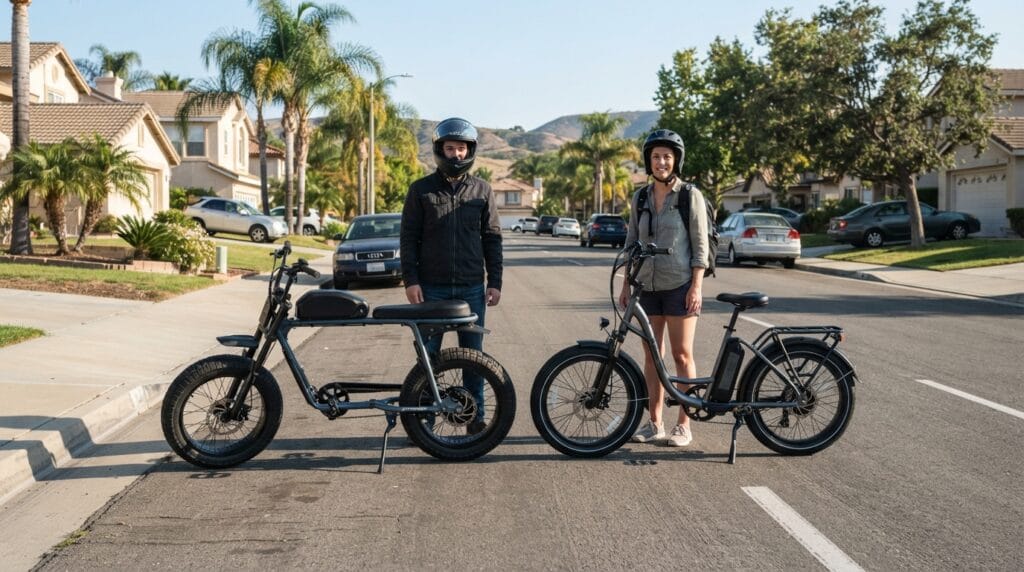
Riverside e-moto accidents are becoming a more important safety issue in 2026. Powerful electric two-wheelers now appear on neighborhood streets, near schools, on bike paths, and around shopping areas throughout Riverside County.
Many of these vehicles look like electric bicycles. However, some can reach motorcycle-level speeds. Others have no working pedals or use motors that exceed California’s limits for legal e-bikes.
That difference matters after a crash. Vehicle classification can affect licensing rules, helmet requirements, roadway access, insurance questions, and the evidence used to determine fault.
The issue became especially timely in September 2026. Riverside County deputies conducted an enforcement operation in Temecula that focused on illegally operated electric motorcycles. Deputies towed several vehicles and issued citations for e-bike and e-moto violations.
For injured riders, parents, motorists, and pedestrians, the key lesson is simple. Do not assume a vehicle is legally an e-bike because a store, website, or rider calls it one.
Why Riverside E-Moto Accidents Are Getting More Attention
Electric bikes have become a popular transportation option across Southern California. They offer lower operating costs, easy parking, and an alternative to short car trips.
However, the market also includes vehicles that look like bicycles but perform more like motorcycles. Some have large batteries, powerful motors, motorcycle-style suspension, thick tires, and high top speeds.
California law draws clear lines between legal electric bicycles and other motor vehicles. Those lines become especially important when a crash causes serious injuries.
California Uses Specific Rules to Define a Legal E-Bike
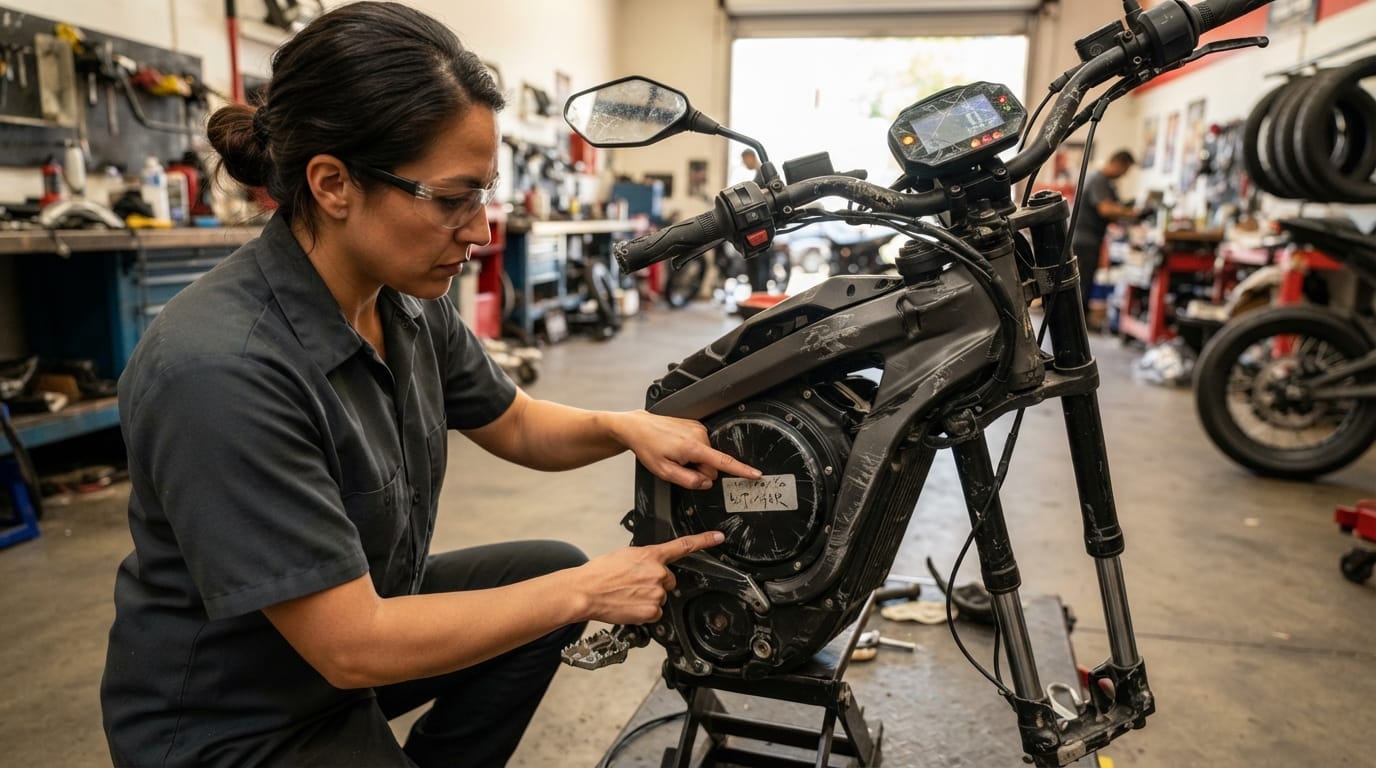
California Highway Patrol explains that a legal electric bicycle must have fully operable pedals and an electric motor below the state’s power limit.
California divides legal e-bikes into three classes. Class 1 provides motor assistance only while the rider pedals and stops assisting at 20 mph. Class 2 may use a throttle, but motor assistance must stop at 20 mph. Class 3 uses pedal assistance and stops assisting at 28 mph.
A Class 3 e-bike also has additional rider restrictions. For example, California requires riders to meet minimum age rules and helmet requirements.
These details are important because a machine that exceeds the limits may fall into another vehicle category.
Motor Power and Pedals Can Change the Legal Classification
California Highway Patrol states that an electric bicycle has fully operable pedals and an electric motor of less than 750 watts.
If a vehicle lacks usable pedals, uses a more powerful motor, or provides assistance beyond the legal speed limits, officials may treat it as something other than an e-bike.
Riverside County officials highlighted this point during the September 2026 enforcement operation. Deputies warned parents that an electric vehicle with no pedals and a motor exceeding 750 watts can qualify as an electric motorcycle.
That may bring motorcycle or motorized-vehicle rules into the analysis.
If your crash involved a traditional motorcycle instead, see our guide to Riverside motorcycle lane-splitting accident claims in 2026.
A Product Listing Does Not Decide What the Vehicle Is
Marketing language can create confusion. A seller may describe a product as an “e-bike,” “electric dirt bike,” “moto bike,” or “off-road e-bike.” Those labels do not replace California vehicle law.
After a serious accident, investigators may need the actual specifications. Important details include motor wattage, maximum assisted speed, throttle operation, pedals, vehicle identification information, and manufacturer warnings.
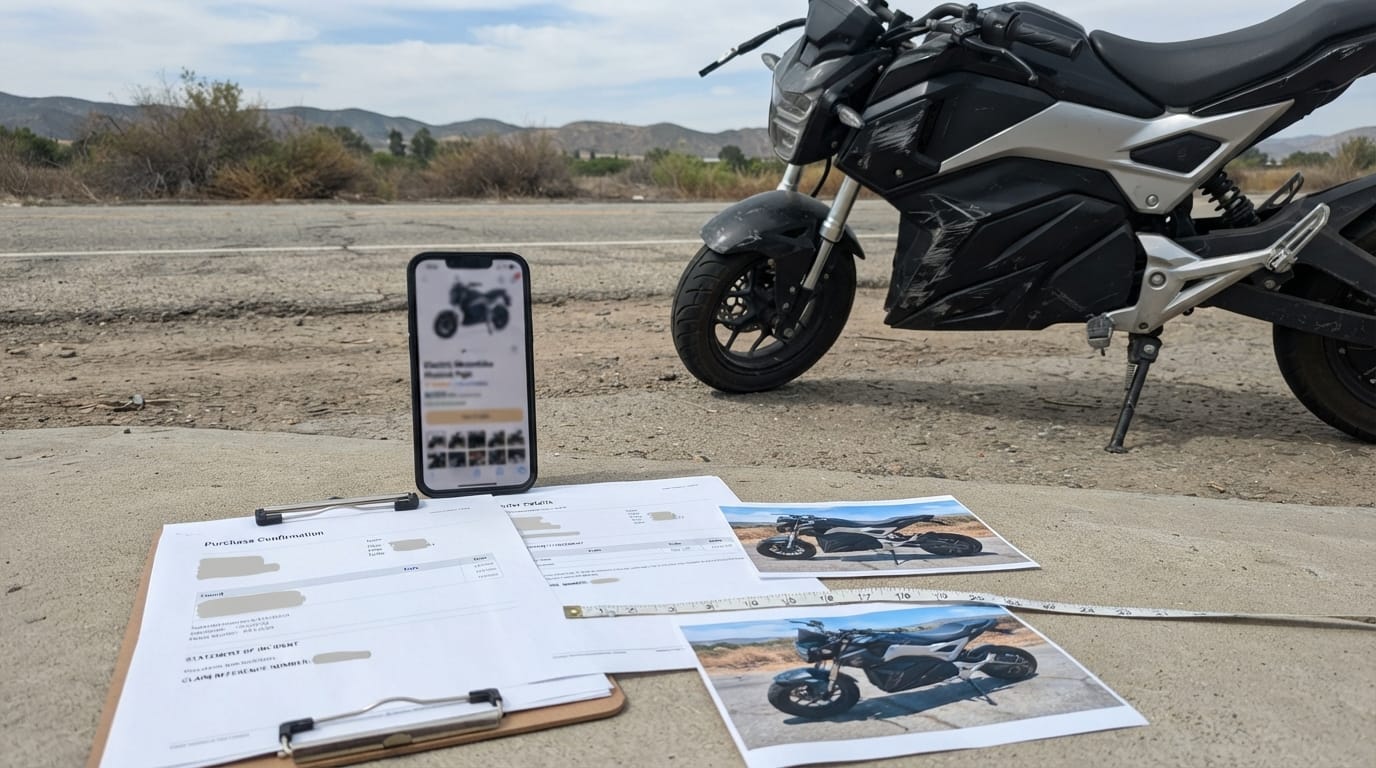
Save screenshots of the original product page when possible. Online listings can change. Sellers may update speed claims, specifications, or usage warnings after a product has already been purchased.
The owner’s manual can also matter. It may identify the intended riding environment and state whether the vehicle was designed only for private property or off-road use.
Vehicle Classification Can Affect an Injury Claim
Classification does not automatically decide who caused an accident. Fault still depends on what happened.
A driver may fail to yield to an e-moto rider. A rider may enter traffic unsafely. A vehicle may travel too fast for conditions. Poor visibility, road defects, distraction, or another person’s actions may also contribute.
California uses comparative negligence. That means more than one person can share responsibility for a collision.
However, classification can add important questions. Was the rider legally allowed to operate that vehicle on the road? Did the rider need a license? Did the vehicle require different safety equipment? Did a retailer market the product as street legal when it was not?
Insurance May Treat an E-Moto Differently From an E-Bike
Insurance becomes another important issue after Riverside e-moto accidents.
A standard bicycle and a motor vehicle may receive different treatment under an auto, homeowners, renters, motorcycle, or specialty insurance policy. Policy definitions and exclusions matter.
Do not assume coverage exists simply because a seller called the vehicle an e-bike. At the same time, do not assume there is no coverage.
Review every potentially relevant policy. If another driver caused the crash, that driver’s liability insurance may still become the main source of recovery. Serious injuries can also raise questions about uninsured or underinsured coverage.
Medical costs often start long before an injury claim resolves. Our guide to who pays medical bills after a Riverside accident explains how treatment expenses can be handled while fault and insurance remain under investigation.
What to Preserve After a Riverside E-Moto Crash
Start with medical care. Electric motorcycles and high-powered e-motos can produce serious injuries because riders have little protection during an impact.
Common injuries may include fractures, head trauma, shoulder injuries, facial injuries, road rash, knee damage, and spinal injuries. Seek prompt evaluation when symptoms appear after a hard crash.
Next, preserve the vehicle. Do not immediately repair, modify, sell, or dispose of it when classification, mechanical performance, or a possible product defect may matter.
Save Vehicle Data, Product Records, and Crash Evidence
Photograph the e-moto from every side. Include the pedals, motor markings, battery label, throttle, display, tires, brakes, and damage.
Save the purchase receipt and owner’s manual. Keep screenshots of the original sales page. Preserve advertisements that mention maximum speed, motor output, age recommendations, or street legality.
If the vehicle connects to a mobile app, preserve available ride data and settings. Avoid resetting software after a serious crash until you know whether the information could matter.
Scene evidence matters too. Photograph road markings, intersections, traffic controls, debris, skid marks, visibility conditions, bike lanes, and nearby cameras.
Digital vehicle evidence can help rebuild the seconds before an impact. Read our guide to Riverside dashcam and black box evidence in 2026 for more on preserving electronic crash information.
Do Not Overlook Product or Modification Evidence
Some e-motos leave the factory with high performance. Others become faster after owners change controllers, software, batteries, motors, or settings.
That difference matters.
If the vehicle was modified, document what changed and who performed the work. Save receipts, parts packaging, software information, messages, and installation records.
A mechanical defect can also create a separate issue. Brake failure, steering problems, battery defects, throttle faults, or structural failures may require a product investigation instead of a simple traffic-fault analysis.
For battery-related injuries, see our article on lithium-ion battery fire injuries in Riverside.
The September 2026 Riverside County enforcement operation shows why electric-vehicle classification has become a live local issue. Deputies contacted juvenile riders, educated families about the rules, towed four electric motorcycles or pocket bikes, and issued 13 citations.
The Riverside County Sheriff’s Office specifically warned that some electric motorcycles are designed only for off-road use and lack required roadway safety equipment.
That does not mean every e-moto rider caused a crash or every high-powered vehicle creates automatic liability. Each injury case still depends on evidence.
However, investigators should identify the machine correctly before analyzing the rest of the claim.
Riverside e-moto accidents may involve traffic negligence, motorcycle rules, insurance disputes, product marketing, vehicle modifications, or several issues at once.
After a serious collision, preserve both the crash evidence and the vehicle itself. Save product specifications. Document modifications. Keep insurance records. Obtain medical treatment and collect witness information.
The difference between an e-bike and an electric motorcycle may look technical. After a crash, it can become one of the most important facts in the entire investigation.
You can review the local enforcement announcement through the Riverside County Sheriff’s Office report on its September 2026 illegal e-motorcycle enforcement operation.
This article provides general educational information and does not constitute legal advice. Vehicle classification, traffic rules, insurance coverage, liability, and filing deadlines depend on the specific facts and applicable law.